Our opening times are Monday - Friday 9am to 5pm and weekends by appointment
Please choose a sub section. Please be aware of the 'Next Page' button at the bottom.
Columns , Pilasters & Capitals
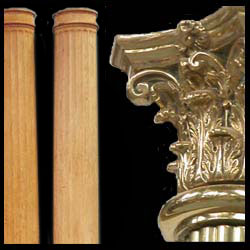
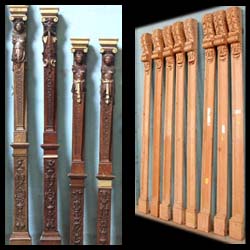
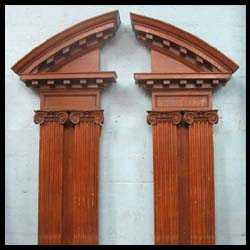
Robert Mills Architectural and Decorative Antiques (Reclamation and Salvage) always has in stock a wide range of reclaimed, salvaged and antique columns, pilasters, capitals and related details. Column, pilasters and capitals come in a variety of types of wood, stone, marble, brass and cast iron and have a variety of uses. Columns can be load bearing or decorative. A column in architecture and structural engineering is a vertical structural element that transmits, through compression, the weight of the structure above to other structural elements below. Other compression members are often termed columns because of the similar stress conditions. Columns can be either compounded of parts or made as a single piece. Columns are frequently used to support beams or arches on which the upper parts of walls or ceilings rest. Column in architecture refers specifically to such a structural element that also has certain proportional and decorative features. The style of the shaft and the capital (the decorative detail that caps the column) describes the order to which the column belongs.![]()
The five main Classical orders are: Doric, Tuscan, Ionic, Corinthian and Composite.
The Doric order is the oldest and simplest of the classical orders. It is composed of a vertical cylinder that is wider at the bottom. It generally has neither a base nor a detailed capital. It is instead often topped with an inverted frustum of a shallow cone or a cylindrical band of carvings. It is often referred to as the masculine order because it is represented in the bottom level of the Colosseum, and was therefore considered to be able to hold more weight. The height-to-thickness ratio is about 4:1. The shaft of a Doric Column is almost always fluted.
The Tuscan order, also known as Roman Doric, is also a simple design, the base and capital both being series of cylindrical disks of alternating diameter. The shaft is almost never fluted. The proportions vary, but are generally similar to Doric columns.
The Ionic column is considerably more complex than the Doric or Tuscan. It usually has a base and the shaft is often fluted (it has grooves carved up its length). On the top is a capital called a volute, or scroll, at the four corners. The height-to-thickness ratio is around 6:1. Due to the more refined proportions and scroll capitals, the Ionic column is sometimes associated with academic buildings.
The Corinthian order is named for the Greek city-state of Corinth, to which it was connected in the period. However, according to the Greek architectural historian Vitruvius, the column was created by the sculptor Callimachus, probably an Athenian, who drew acanthus leaves growing around a votive basket. In fact, the oldest known Corinthian capital was found in Bassae, dated at 427 BC. It is sometimes called the feminine order because it is on the top level of the Colosseum and holding up the least weight, and also has the slenderest ratio of thickness to height.
The Composite order draws its name from the capital being a composite of the Ionic and Corinthian capitals. The acanthus of the Corinthian column already has a scroll-like element, so the distinction is sometimes subtle. Generally the Composite is similar to the Corinthian in proportion and employment, often in the upper tiers of colonnades.
References and Links
http://en.wikipedia.org/wiki/Column
http://en.wikipedia.org/wiki/Category:Architectural_elements
Inside Churches pub. Nadfas
http://en.wikipedia.org/wiki/Capital_%28architecture%29
http://www.lookingatbuildings.org.uk/default.asp?document=2.30