Cornices, Mouldings and Friezes

Our opening times are Monday - Friday 9am to 5pm and weekends by appointment 

Please choose a sub section and check the 'next page' button at the bottom.

Cornices, Friezes and Moldings
Robert Mills Architectural and Decorative Antiques (Reclamation and Salvage) always has in stock a wide range of antique, reclaimed and salvaged decorative cornices, mouldings and friezes.  Our antique and reclaimed mouldings are salvaged from various locations including grand private mansions, commercial refurbishment projects, public buildings and churches awaiting demolition.  Often we manage to save the materials at the very last minute before it goes to shredding, landfill or the bonfire.  We are proud of our contribution to the reuse of such materials.Reclaimed Pine Dentil Frieze & Corbels

The term cornice comes from Italian cornice, meaning "ledge"  Cornice molding is generally any horizontal decorative molding which crowns any building or furniture element: the cornice over a door or window, for instance, or the cornice around the edge of a pedestal. A simple cornice may be formed just with a crown molding.  The function of the projecting cornice is to throw rainwater free of the building's walls. In residential building practice, this function is handled by projecting gable ends, roof eaves and gutters. The complete elimination of the cornice has been important enough in modernist architecture, often simply for demands of style, that elaborate internal drainage systems are provided.  The cornice molding is the set of projecting moldings that crown an entablature along the top edge of a temple or building. The cornice lies above the frieze, which rests on the architrave, all supported by columns.  The sloping cornice, "raking cornice" or "rake board", is also carried across the top of the triangular pediment, at the gable end of a building. (refer to image), found on the front of such buildings as the Parthenon, the Acropolis or Schinkel's Schauspielhaus. The sloping cornice hangs over the end of the structure supporting the roof. In classical and neoclassical architecture, the sloping cornice uses the same molding profile as the cornice below.  In architecture the Frieze is the wide central section part of an entablature and may be plain or decorated with bas-reliefs. In an astylar wall it lies upon the architrave ('main beam') and is capped by the moldings of the cornice.  In interiors, the frieze of a room is the section of wall above the picture rail and under the crown moldings or cornice. By extension, a frieze is a long band of painted, sculpted or even calligraphic decoration in such a position, above eye-level. Frieze decorations may depict scenes in a sequence of discrete panels. The material of which the frieze is made may be plasterwork, carved wood or other decorative medium.  In an example of an architectural frieze on the facade of a building, the octagonal Tower of the Winds in the Roman agora at Athens bears bas-relief sculptures of the eight winds on its frieze.  Molding   is a strip of material with various cross sections used to cover transitions between surfaces or for decoration. It is traditionally made from solid milled wood or plaster but may be made from plastic or reformed wood.A "sprung" molding is a strip that has beveled edges, allowing it to be mounted at an angle between two non-parallel planes (such as between a wall and a ceiling). Other types of molding are referred to as "plain".

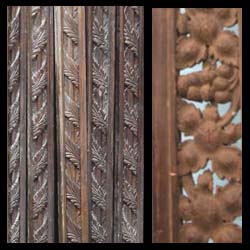
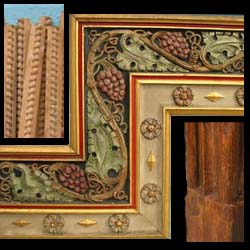
Some common friezes and moldings: Acanthus; Ball Flower; Bay Leaf; Bead; Bead and Real; Birfucated; Billet; Btattishing; Chevron; Dentil; Double Cone; Egg and Tongue; Egg and Dart; Embattled; Festoon; Fleur-de-Lys; Key; Lobing; Imbricated; Knotwork; Lozenge; Lunette; Meander; Nailhead; Ovolo; Peardrop;Plait; Reeding or Fluting; Ribbon; Scalloped; Scroll; Shell; Swag; Tracery; Tudor Rose; Vine. 

References and Links

http://en.wikipedia.org/wiki/Molding_%28decorative%29
http://en.wikipedia.org/wiki/Frieze
http://en.wikipedia.org/wiki/Cornice
Inside Churches pub. NADFAS