Our opening times are Monday - Friday 9am - 5pm and Saturday 10am - 4pm. We are not open Sundays or bank holidays.
Please choose a sub section and check the 'next page' button at the bottom.
High Panelling
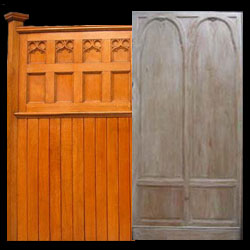
Robert Mills Architectural and Decorative Antiques (Reclamation and Salvage) always has in stock a wide range of full height antique wall panelling, salvaged and reclaimed runs of panelling and panelled rooms, mostly Victorian but ranging from the 17th century to the 1930s. We are one of the largest high quality reclamation specialists and suppliers of fine architectural antiques and salvage in the UK. In this section you will also find panelled rooms, including a magnificent highly carved oak linenfold panelled room from Hampsfield House, a smaller linenfold room with a rich patina and polychromed fire surround with gothic details thoughout and a handsome 1930s Art Deco full height panelled room with remote opening cocktail cabinet and entry doors.
Our reclaimed and antique panelling is salvaged from various locations including commercial refurbishment projects, private mansions, public buildings and churches awaiting demolition. Often we manage to save the material at the very last minute before it goes to landfill or the bonfire. ![]()
Early panelling was used to cover bare walls instead of wall hangings and tapestry.
Tudor style oak panelling tended to have very small square panels. Victorian panelling often had raised and fielded panels. Linenfold panelling was also typical of the Victorian period with the wood carved to look like folded material.
Georgian panelling, in much less supply, has a low moulded rail often known as a chair rail to protect the panelling from being knocked by chair backs and a large panel above. Georgian panelling was normally made of pine and painted.
Later, in Victorian times, the moulded rail was set higher and called a dado rail.
Panelling is a blanket term for wall coverings constructed from rigid or semirigid components. These are traditionally interlocking wood, but could be plastic or other materials. Panelling was developed in antiquity, to make rooms in stone buildings more comfortable. The panels served to insulate the room from the cold stone. In more modern buildings such panelling is often installed for decorative purposes. Panelling such as wainscoting and boiserie in particular may be extremely ornate, and are particularly associated with 17th and 18th century interior design, Victorian architecture in Britain and its international contemporaries. Wainscot or wainscoting was originally a panelling style applied to the lower 1.2 to 1.5 m of an interior wall, below the dado rail or chair rail and above the skirting board or baseboard. It is traditionally constructed from tongue-and-groove boards, though beadboard or decorative panels (such as a wooden door might have) are also common. Wainscoting may also refer to other materials used in a similar fashion. Its original purpose was to cover the lower part of walls which, in houses constructed with poor or nonexistent damp-proof courses, are often affected by rising dampness. The panelling's purpose is now generally decorative. Boiserie (often used in the plural boiseries) is the term to used to define ornate and intricately carved wood panelling. Early examples of boiseries were unpainted, but later the raised moldings were often painted or gilded. Boiseries were popular in 17th and 18th century French interior design and the Palace of Versailles has many fine examples. The panels were not confined just to the walls of a room but were also used to decorate doors, frames, cupboards and shelves. Often pictures would be set into the boiseries, the carving framing the picture rather like a conventional frame.
References & Links:
http://en.wikipedia.org/wiki/Panelling
http://www.victorian-society.org.uk/
http://en.wikipedia.org/wiki/Dado_%28architecture%29
http://www.vam.ac.uk/collections/architecture/index.html
http://www.lookingatbuildings.org.uk/default.asp?document=3.C
http://www.architecturecentre.co.uk/
http://visitbristol.co.uk/